FAQ

Inclinometers & Pendulums

Cos’ è il supporto a parete 0TEL310ANS0 per TEL-310S e a cosa serve? 

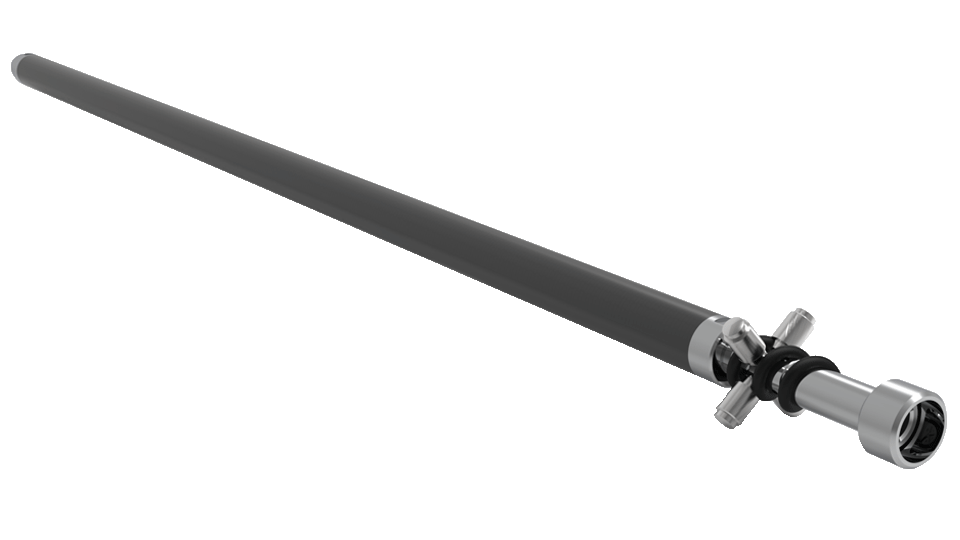
Il supporto a parete “ANS” (0TEL310ANS0) è stato sviluppato per sostenere e fissare l’unità ottica “SUS” (0TEL310SUS0) del nuovo telecoordinometro TEL-310S.
Il supporto viene fissato alla parete tramite due barre filettate M16 lunghe 370mm (fornite in dotazione).
Una volta fissata l’ unità ottica “SUS” al supporto stesso è possibile eseguire la regolazione in modo da posizionare il filo a piombo del pendolo nella posizione voluta all’ interno del campo di misura dello strumento.

Inclinometers & Pendulums

Quali sono le condizioni necessarie per l’utilizzo del supporto a parete “ANS” per TEL-310S dovendo monitorare il filo a piombo di un pendolo diritto?

unità ottica sus Per poter fissare l’ unità ottica “SUS” alla parete tramite il supporto “ANS” è necessario che il filo a piombo del pendolo diritto sia ad una distanza d=230mm dalla parete.
Per ottenere questa condizione, la vasca del pendolo diritto deve essere posizionata ad una distanza D=20mm dalla parete: in questo modo si garantisce il posizionamento del filo a piombo del pendolo esattamente al centro del campo di misura dell’unità ottica “SUS”.

Inclinometers & Pendulums

Quali sono le condizioni necessarie per l’utilizzo del supporto a parete “ANS” per TEL-310S dovendo monitorare il filo a piombo di un pendolo rovescio?

Per poter fissare l’ unità ottica “SUS” alla parete tramite il supporto “ANS” è necessario che il filo a piombo del pendolo rovescio sia ad una distanza d=230mm dalla parete.
Per ottenere questa condizione, è necessario che sia eseguita una nicchia e una mensola.
La nicchia dovrà avere le seguenti dimensioni indicative: altezza 650mm, larghezza 800mm e profondità 200mm. In questo modo si garantisce il posizionamento del filo a piombo del pendolo al centro del campo di misura dell’unità ottica “SUS”.

Inclinometers & Pendulums

E’ possibile posizionare l’unità ottica “SUS” del TEL-310S con l’asse X perpendicolare alla parete dove è fissato il supporto “ANS”?

Il telecoordinometro  TEL-310S possiede il seguente campo di misura:
•    asse X: 145mm (150mm nominali),
•    asse Y: 60mm.
L’ utilizzo del supporto a parete “ANS” obbliga ad avere l’ asse X parallelo alla parete: non è quindi possibile fissare l’ unità ottica “SUS” perpendicolarmente alla parete utilizzando il supporto “ANS”.

Inclinometers & Pendulums

E’ possibile fissare a pavimento il supporto “ANS” per TEL-310S?

Essendo il supporto “ANS” snodabile, questo può essere fissato al pavimento; ciò può essere utile nel caso il filo a piombo del pendolo sia ad una distanza non congrua (eccessiva) dalle pareti.

Inclinometers & Pendulums

E’ possibile utilizzare il supporto a parete “ANS” del TEL-310S per il coordinometro ottico manuale?

La piastra del coordinometro ottico presenta quattro fori per poterla fissare, tramite altrettante viti, al supporto a parete “ANS”.

Le condizioni necessarie per l’ utilizzo del coordinometro fissato sul supporto a parete “ANS” sono le stesse riportate in precedenza per l’unità ottica “SUS” del TEL-310S.

Inclinometers & Pendulums

In caso di rimozione dell’unità ottica “SUS” del TEL-310S per assistenza, è possibile continuare il monitoraggio utilizzando il coordinometro ottico manuale?

E’ possibile utilizzare il coordinometro ottico manuale al posto dell’unità “SUS” del TEL-310S senza eseguire alcuna regolazione del supporto a parete “ANS”.
E’ altresì possibile iniziare il monitoraggio del pendolo con il coordinometro ottico manuale ed in un secondo momento automatizzare le letture con il telecoordinometro TEL-310S senza dover modificare il suo zero iniziale.

Inclinometers & Pendulums

Le unità di controllo “CUS” e di alimentazione “PWS” del TEL-310S vengono fornite con kit di fissaggio?

No, non è necessario alcun kit. Le unità CUS e PWS sono alloggiate in cassette di alluminio predisposte per il fissaggio a parete tramite quattro viti M6 (non fornite).

Inclinometers & Pendulums

Cos’ è il kit montaggio / controllo 0TEL310CAL0 e a cosa serve?

Il kit 0TEL310CAL0 è composto da una dima per la foratura della parete dove sarà posizionato il supporto “ANS” ed una dima da posizionare sull’ unità ottica “SUS” per effettuare un eventuale controllo funzionale in campo (simulazione filo a piombo del pendolo)

Inclinometers & Pendulums

Il funzionamento del TEL-310S può essere influenzato da fattori atmosferici?

Qualsiasi fattore (acqua, fango etc) che possa sporcare la faccia esterna della parte interna del coperchio dell’ unità “SUS” può influenzare il corretto funzionamento del TEL-310S. E’ pertanto indispensabile proteggere adeguatamente dagli agenti atmosferici l’ unità ottica “SUS” lasciando però la possibilità di accesso per la pulizia / manutenzione.
Il TEL-310S è comunque dotato di auto-diagnostica in grado di avvertire l’ utente per manutenzione.

Esempio di soluzione adottata per proteggere lo strumento (vecchio TEL-310) dagli agenti esterni

Settlement Gauges

Which is the freezing temperature of the DSM system liquid?

DSM liquid is a mix of 50% glycerin and 50% water. This mix have a freezing temperature of about -23°C.

Settlement Gauges

Are the air bubbles present in the DSM liquid cause of errors?

DSM liquid is de-aired at factory and it is supplied sealed in special tank. However in the DSM reference gauge there is a high sensitive sensor which is able to monitor the weight of the liquid within the reservoir. In the case of the air bubbles come over decreasing the level of the liquid in the reservoir the sensor measures this change. Thus air bubbles are not usually a problem.

Settlement Gauges

How is important the function of the grout to the operation of the spider magnets?

The arms of the spider only keep the magnet in place while grouting, but the grout couples the magnet to the surroundig soil. Grout mix shall be controlled (ratio water/cement) during grouting operation according to the soil application.

Settlement Gauges

The DSM reference gauge has a liquid reservoir open to the atmosphere. How can the atmosphere, which acts on the surface of the liquid in the reservoir, affects the settlement readings?

The DSM pressure gauges are vented to atmosphere by special electric vented cable. Therefore the DSM system is not affected by changes in atmospheric pressure.

Settlement Gauges

What is the DSM settlement system to monitor settlement in embankment fills and foundation soil?

The DSM settlement system consists of four main components: a string of DSM pressure gauges, a liquid filled tubes, electric cables and a DSM reference gauge with reservoir of liquid. The DSM pressure gauges are embedded in the soil and by tubing connected to the DSM reference gauge which shall be located at higher elevation on a stable ground, away from the construction activities. The DSM pressure gauges measure the pressure created by the liquid column in the tubing. The height of the liquid column is equal to the difference in elevation between the DSM pressure gauges and the DSM reference gauge. Electric cables provide connection to ADK-10 data acquisition unit for automatic monitoring.

Load Cells

The anchor load value displayed on the load cell digital indicator does not agree with load calculated by the hydraulic jack. What’s right?

The main factors which influence the anchor measurements are: – axial misalignment of the jack, – difference in diameter between the jack and the load cell. These factors cause bending of the bearing plate between the load cell and the jack and affects the response of the cell. To minimise this effect use the genuine distribution plate which loads properly the sensitive upper ring of the load cell.

Piezometers

Are the vibrating wire piezometers equipped with temperature sensors, or is the temperature sensor an option?

Yes, each vibrating wire piezometer is equipped with a built-in NTC thermistor YSI 44005 type (3000 Ohm at 25°C). Thermistor is not a option for vibrating wire instruments and therefore there is not additional cost for it.

Piezometers

Can we buy spare parts for replacement of the water level indicator probe and repair it ourselves?

Yes, we sell a kit which includes instructions, probe, weights, rexin, and any other parts.

Piezometers

What kind of overvoltage protection is built in the vibrating wire piezometers?

A plasma surge arrestor is wired in parallel with the coil (which is used to pluck the wire). The nominal impulse discharge current 8-20 microsec interval is 10 KA. Impulse spark-over voltage at 1Kv/ microsec: 700 V.

Piezometers

Which is the difference between HAE (high-air entry) and LAE (low-air entry) filters?

HAE filters are normally used to monitor pore pressure in the clay core dams and saturated low permeability soils. “High air entry” means high-resistance to air entry when the filter is saturated. The surface tension of the water in the very fine pores of the filter prevents entry of air. The HAE filters must be saturated before installation by means of the saturation device.

Pressure Cells

How to obtain better results from pressure cells installed in earthfill?

The measurement of total pressure in geomechanics, even if is one of the most interesting parameters for the designer, is generally considered not reliable. Case histories report more nonsuccessful examples than for all the other types of measurements. Theoretical studies made by many researches have highlighted the critical parameters in the design and manufacturing of pressure cells. If the instruments are accurately designed and manufactured and the choice of the model has been done properly, the problem becomes how to use the cell. In the paper presented by Mr. D. Bruzzi and Mr. A. Zattoni (SISGEO) and Mr. G. Pezzetti (ISMES) at 5TH International Simposium FMGM/99 in Singapore, the authors discuss the main issues related both to laboratory calibration and field installation problems, and a practical approach is presented in order to improve the quality of the results. The conclusion is that pressure cells provide relative measures that can become absolute by using simple and practical rules deriving from a good knowledge of the basic problems related to design, manufacturing and installation of total pressure cells. For a complete view of this paper, click here to download the .pdf file.

Pressure Cells

Is the repressurizing hand pump for NATM pressure cells filled by de-aired oil, ready to use? Which kind of oil is used for this purpose?

Yes it is. The pump is filled at factory under vacuum with de-aired oil. For normal use within concrete the oil inside the pump is enough to repressurize 50 pcs. of NATM pressure cells. The oil we use is Edwards Ultra-grade 19 type for vacuum-pump use .

Pressure Cells

Why do the NATM pressure cells have repressurizing tubes?

NATM pressure cells are normally used to measure tangential and radial stresses in concrete tunnel lining. They are embedded in concrete and after curing the cell shall be repressurized to mantain the intimate contact between the pessure pad and the surrounding material.

Inclinometers & Pendulum

For obtaining best results with inclinometer, must the borehole be very close to the vertical?

Borehole should be drilled as close to the vertical as possible, however 2/3 degrees from vertical are normally accepted in specifications.

Inclinometers & Pendulum

How can we keep efficiently the inclinometer operating cable?

A good practice for the inclinometer users is to follow these simple recommendations: – when you connect the inclinometer operating cable to the probe, avoid overtightening the nut, since this will flatten the O-ring and reduce its effectiveness; – use a pulley assembly. It protects the inclinometer operating cable and provides a good reference index; – when very high precision is expected, it may be useful to periodically record the date and the precise length of your inclinometer operating cable; – perform regular maintenance.

Inclinometers & Pendulum

How get good readings with inclinometer probe?

A good practice for getting good readings with inclinometer probe is to follow these simple operations: – Use the same probe for each survey, if possible; – if you must use a different probe, be sure to note the serial number of the probe used for each survey, so any necessary corrections can be made during data processing; – protect the probe from shock, which contributes to zero shift and sensor rotation. Transport the probe in its carrying case. – power up the probe before you lower it into the borehole. – wait 10 minutes for the probe to adjust to the temperature of the borehole up to the displayed readings will be stabilized within two units and validate data; – validate data on site using checksum statistics, if you are using the Nadir readout.

Inclinometers & Pendulum

The inclinometer probe shows jump in the check-sum displayed on the Nadir readout. Does it indicate a problem?

A jump in the check-sum does not indicate necessarily a problem. However if the Nadir readout shows frequent jumps in the check-sum or if consistent check-sums in the range of 35 to 40 are diplayed, it may be time to return the whole system (probe-cable-readout) to the Manufacturer for checking. Checksums of 10 or 20 are within the manufacturer specifications.

Inclinometers & Pendulum

What can we do when the inclinometer casing tends to float in grout?

If the water filled casing is lighter than grout backfill the uplift force of grout varies with the height of the grout column. If the column is short, the uplift force is low and the casing can be held in place by its own weight or with very little down-force applied from the top. When the grout sets, the bottom cap is isolated from the column of grout and there is no surface for the uplift force to act on. No more than two or three meters to 3 m need to be grouted in the first stage. If the normal bentonite/cement grout is used it needs to set for at least 12 hours before second-stage grouting. Avoid use of a quick-set grout, since the heat of hydration could melt and deform the plastic. The two stages can be placed via an outside tremie pipe. Alternatively the first stage can be placed before lowering the casing, provided that all is done efficiently so that there is no chance of the grout setting prematurely.

Inclinometers & Pendulum

Which type of damping fluid is recommended for filling the pendulum tanks?

We recommend to use the following mineral oil with selected viscosity: – SAE 50-90 for direct pendulums, – SAE-10 for inverted pendulums.

Strain Gauges

Are the vibrating wire strain-gauges equipped with temperature sensors?

Yes, vibrating wire strain-gauges are equipped with a built-in NTC thermistor YSI 44005 type (3000 Ohm at 25°C). Thermistor is included in the instrument price and therefore there is not additional cost for it.

Strain Gauges

What is the “Real Gauge Factor” reported in the Specifications and Compliance Certificates of both VW embedded and arc-weldable strain-gauges?

The gauge factors for VW strain-gauges are generic factors calculated from the dimensions and the physical properties of the gauge material. The VW strain-gauges are not individually calibrated. The “Real Gauge Factor” is obtained by carrying out calibration on selected strain gauges from each manufacturing batch.

Strain Gauges

Why has not been sent with the instruments that I have ordered (Vibrating Wire Strain Gauges) the Calibration Certificate?

Generally the “Calibration Certificate” for this kind of product is not supplied together with the goods because all the necessary information are reported in the “Specification and Compliance Certificate”. The Gauge Factor is the same for each Vibrating Wire Strain Gauge. If for any reason the client need a Calibration Certificate, it could be requested at the order.

Software

How can we purchase Data Analyzer software via Internet?

Data Analyzer softwares are available for processing measurements carried out from different instruments. The complete list of Data Analyzer softwares is available on Sisgeo web site in the “Product” area. For buying data Analyzer software via Internet: – choose the data Analyzer software from the list – click on it and open its technical page – download the software and install it on your PC – opening the software and use it for 10 days free period – if the software satisfies your requirement duly fill the registration form following the instructions and send it to Sisgeo.

Pressure Cells

Is the repressurizing hand pump for NATM pressure cells filled by de-aired oil, ready to use? Which kind of oil is used for this purpose?

Yes it is. The pump is filled at factory under vacuum with de-aired oil. For normal use within concrete the oil inside the pump is enough to repressurize 50 pcs. of NATM pressure cells. The oil we use is Edwards Ultra-grade 19 type for vacuum-pump use .

Pressure Cells

Why do the NATM pressure cells have repressurizing tubes?

NATM pressure cells are normally used to measure tangential and radial stresses in concrete tunnel lining. They are embedded in concrete and after curing the cell shall be repressurized to mantain the intimate contact between the pessure pad and the surrounding material.

Inclinometers & Pendulum

For obtaining best results with inclinometer, must the borehole be very close to the vertical?

Borehole should be drilled as close to the vertical as possible, however 2/3 degrees from vertical are normally accepted in specifications.

Inclinometers & Pendulum

How can we keep efficiently the inclinometer operating cable?

A good practice for the inclinometer users is to follow these simple recommendations: – when you connect the inclinometer operating cable to the probe, avoid overtightening the nut, since this will flatten the O-ring and reduce its effectiveness; – use a pulley assembly. It protects the inclinometer operating cable and provides a good reference index; – when very high precision is expected, it may be useful to periodically record the date and the precise length of your inclinometer operating cable; – perform regular maintenance.

Inclinometers & Pendulum

How get good readings with inclinometer probe?

A good practice for getting good readings with inclinometer probe is to follow these simple operations: – Use the same probe for each survey, if possible; – if you must use a different probe, be sure to note the serial number of the probe used for each survey, so any necessary corrections can be made during data processing; – protect the probe from shock, which contributes to zero shift and sensor rotation. Transport the probe in its carrying case. – power up the probe before you lower it into the borehole. – wait 10 minutes for the probe to adjust to the temperature of the borehole up to the displayed readings will be stabilized within two units and validate data; – validate data on site using checksum statistics, if you are using the Nadir readout.

Inclinometers & Pendulum

The inclinometer probe shows jump in the check-sum displayed on the Nadir readout. Does it indicate a problem?

A jump in the check-sum does not indicate necessarily a problem. However if the Nadir readout shows frequent jumps in the check-sum or if consistent check-sums in the range of 35 to 40 are diplayed, it may be time to return the whole system (probe-cable-readout) to the Manufacturer for checking. Checksums of 10 or 20 are within the manufacturer specifications.

Inclinometers & Pendulum

What can we do when the inclinometer casing tends to float in grout?

If the water filled casing is lighter than grout backfill the uplift force of grout varies with the height of the grout column. If the column is short, the uplift force is low and the casing can be held in place by its own weight or with very little down-force applied from the top. When the grout sets, the bottom cap is isolated from the column of grout and there is no surface for the uplift force to act on. No more than two or three meters to 3 m need to be grouted in the first stage. If the normal bentonite/cement grout is used it needs to set for at least 12 hours before second-stage grouting. Avoid use of a quick-set grout, since the heat of hydration could melt and deform the plastic. The two stages can be placed via an outside tremie pipe. Alternatively the first stage can be placed before lowering the casing, provided that all is done efficiently so that there is no chance of the grout setting prematurely.

Inclinometers & Pendulum

Which are the recommended grout mix for inclinometers?

For soft soils: – 25 kg of cement (one bag), 150 lt of water, 10 kg of bentonite. For medium/hard soils: – 25 kg of cement (one bag), 60 lt of water, 7.5 kg of bentonite. Mix cement and water first, than mix it with bentonite. Adjust the amount of bentonite to obtain a grout with a consistency of heavy cream.

Inclinometers & Pendulum

Which type of damping fluid is recommended for filling the pendulum tanks?

We recommend to use the following mineral oil with selected viscosity: – SAE 50-90 for direct pendulums, – SAE-10 for inverted pendulums.

Strain Gauges

Are the vibrating wire strain-gauges equipped with temperature sensors?

Yes, vibrating wire strain-gauges are equipped with a built-in NTC thermistor YSI 44005 type (3000 Ohm at 25°C). Thermistor is included in the instrument price and therefore there is not additional cost for it.

Strain Gauges

What is the “Real Gauge Factor” reported in the Specifications and Compliance Certificates of both VW embedded and arc-weldable strain-gauges?

The gauge factors for VW strain-gauges are generic factors calculated from the dimensions and the physical properties of the gauge material. The VW strain-gauges are not individually calibrated. The “Real Gauge Factor” is obtained by carrying out calibration on selected strain gauges from each manufacturing batch.

Strain Gauges

Why has not been sent with the instruments that I have ordered (Vibrating Wire Strain Gauges) the Calibration Certificate?

Generally the “Calibration Certificate” for this kind of product is not supplied together with the goods because all the necessary information are reported in the “Specification and Compliance Certificate”. The Gauge Factor is the same for each Vibrating Wire Strain Gauge. If for any reason the client need a Calibration Certificate, it could be requested at the order.

Software

How can we purchase Data Analyzer software via Internet?

Data Analyzer softwares are available for processing measurements carried out from different instruments. The complete list of Data Analyzer softwares is available on Sisgeo web site in the “Product” area. For buying data Analyzer software via Internet: – choose the data Analyzer software from the list – click on it and open its technical page – download the software and install it on your PC – opening the software and use it for 10 days free period – if the software satisfies your requirement duly fill the registration form following the instructions and send it to Sisgeo.

Strain Gauges

What is the “Real Gauge Factor” reported in the Specifications and Compliance Certificates of both VW embedded and arc-weldable strain-gauges?

The gauge factors for VW strain-gauges are generic factors calculated from the dimensions and the physical properties of the gauge material. The VW strain-gauges are not individually calibrated. The “Real Gauge Factor” is obtained by carrying out calibration on selected strain gauges from each manufacturing batch.

Strain Gauges

Why has not been sent with the instruments that I have ordered (Vibrating Wire Strain Gauges) the Calibration Certificate?

Generally the “Calibration Certificate” for this kind of product is not supplied together with the goods because all the necessary information are reported in the “Specification and Compliance Certificate”. The Gauge Factor is the same for each Vibrating Wire Strain Gauge. If for any reason the client need a Calibration Certificate, it could be requested at the order.

Software

How can we purchase Data Analyzer software via Internet?

Data Analyzer softwares are available for processing measurements carried out from different instruments. The complete list of Data Analyzer softwares is available on Sisgeo web site in the “Product” area. For buying data Analyzer software via Internet: – choose the data Analyzer software from the list – click on it and open its technical page – download the software and install it on your PC – opening the software and use it for 10 days free period – if the software satisfies your requirement duly fill the registration form following the instructions and send it to Sisgeo.

Settlement Gauges

Is the DEX system suitable for in-place applications?

DEX system has been designed for automatic soil settlement monitoring (vertical movement) in unattended location. DEX system consists of a string of DEX probes installed in borehole within a ABS inclinometer casing. DEX-S, the combined inclinometer-settlement probe, provides both horizontal movements (X, Y-axis) and vertical settlement (Z-axis) for 3-D borehole automatic profile monitoring.

READOUT UNITS AND DATALOGGERS

Which is the reading method of the new generation of Sisgeo vibrating wire readouts?

Galileo and Volta readouts use a spectral interpolation method that samples the vibrating wire and performs a fast Fourier transform (FFT) to provide a frequency spectrum that can distinguish between the natural frequency and the noise frequencies thereby greatly reducing measurement errors and false alarms, the method also provides much improved resolution.

SOFTWARE

I have upgraded the Operative System of my PC to Windows Vista and now I cannot connect the ADK-10 Datalogger and the Portable Datalogger (Archimede, Leonardo, New Leonardo and Galileo) to my PC/Notebook. How could I solve the problem?

In order to use the USB direct connection between the Dataloggers and the PC/notebook with Vista OS, it is necessary to upgrade the driver of the RS232/USB converter. The upgrade is available on the products page at the following link: click here

ASSISTANCE

I have lost the Calibration Report of an instrument. What can I do?

You could ask a copy or an original of your certificates just by clicking on the “Assistance” section of our web site; choose “Request of calibration reports” and follow the instruction. For futher information, clik on the following link: click here

PIEZOMETERS

I have received the calibration Report of a piezometer. There is not the K Thermal Factor noted. In which way may I proceed?

If the value is not indicated in the Calibration Report, you should use this formula: K = -1 digit/°C For each degree of increase of temperature you should reduce 1 digit.

LOAD CELLS

Is possible to repair/change the manometer without disassemble the load cell?

It is not possible to repair/change the manometer without disassemble the load cell. The scope of the glycerine inside of the manometer display is only to show eventual tampering of the manometer. The load cell work properly without glycerine, too.

SETTLEMENT GAUGES

In what consists a profiler? Which is its function?

The profiler consists of:
> – a stainless steel measurement sensor for pressure measures;
> – a cable reel containing the liquid tank;
> – an electro-hydraulic cable for signals transmission;
> – a tripod on which the reel/tank should be positioned.

The electro-hydraulic cable follows the probe (measuring sensor) to which it is connected. A small steel cable to pull the profiler probe is also provided; it should be situated into the same HDPE tube where the probe pass through (readings with two operators with both sides of HDPE tube accessible) or in a second tube located parallel to the first one (readings with one operator or one not-accessible side; in this last case a pulley system is recommended).

Finally, what you need to execute readings with the profiler is only a probe in HDPE with diameter ≥ 50 mm. We suggest you the HDPE and not a metallic tube because this kind of tube (without crash-it) must be adapted to the embankment differential settlements. It is advised to use a HDPE tube with diameter which is not more than 50mm to avoid mistakes or less accuracy in readings.

INCLINOMETERS

Which is the right mix for inclinometer casing grouting?

There is not an exact ratio for each kind of soils. It depends from the consistency and from others many factors that could change for every geological and geotechnical situation. In every case the technician has to adjust the amount of bentonite to produce a grout with the consistency of heavy cream. If the grout is too thin, the solids and the water will separate while if the grout is too thick, it will be difficult to pump. This is the correct procedure of mix grouting:

1) Mix cement with water first,
2) then mix in the bentonite.
It is not really practical try to match the strength of the grout to the strength of the soil, since the properties of grout and soil are so differents. Cement-water ratio controls the strength of the grout. To decrease the strength of the grout, add more water. Use low pressure and low flow until the undiluted mix flows back to grout surface. We suggest these theoretical ratios for the these general kind of soils:
Theoretical Grouting Mix for Hard and Medium Soils:

Materials Weight Ratio by Weight
Cement 40 kg (1 bag) 1
Water 120 litre 2,5
Bentonite 12 kg (as required) 0,3

Theoretical Grouting Mix for soft Soils:

Materials Weight Ratio by Weight
Cement 40 kg (1 bag) 1
Water 285 litre 6,6
Bentonite 18 kg (as required) 0,4

PIEZOMETERS & SETTLEMENT GAUGES

Which is the linear thermal expansion coefficient of the graduated flat cable (tape) of Water Level Indicators (WLI) and BRS settlement probes?

The linear thermal expansion coefficient of the flat graduated cable is 16x10E-6 m/m °C.